
Navigating the 2026 Great Firewall: The New B2B Marketing Entry Points in China
1. The Counter-Intuitive Opening: Why Your Website is No Longer Your Homepage
In the Western digital landscape, the corporate website is the sun around which all marketing satellites orbit. In China’s 2026 digital ecosystem, that model is a relic of the past. China has finalized its evolution into a series of “Walled Gardens”—closed, mobile-first ecosystems where data, user behavior, and commercial transactions are strictly contained.
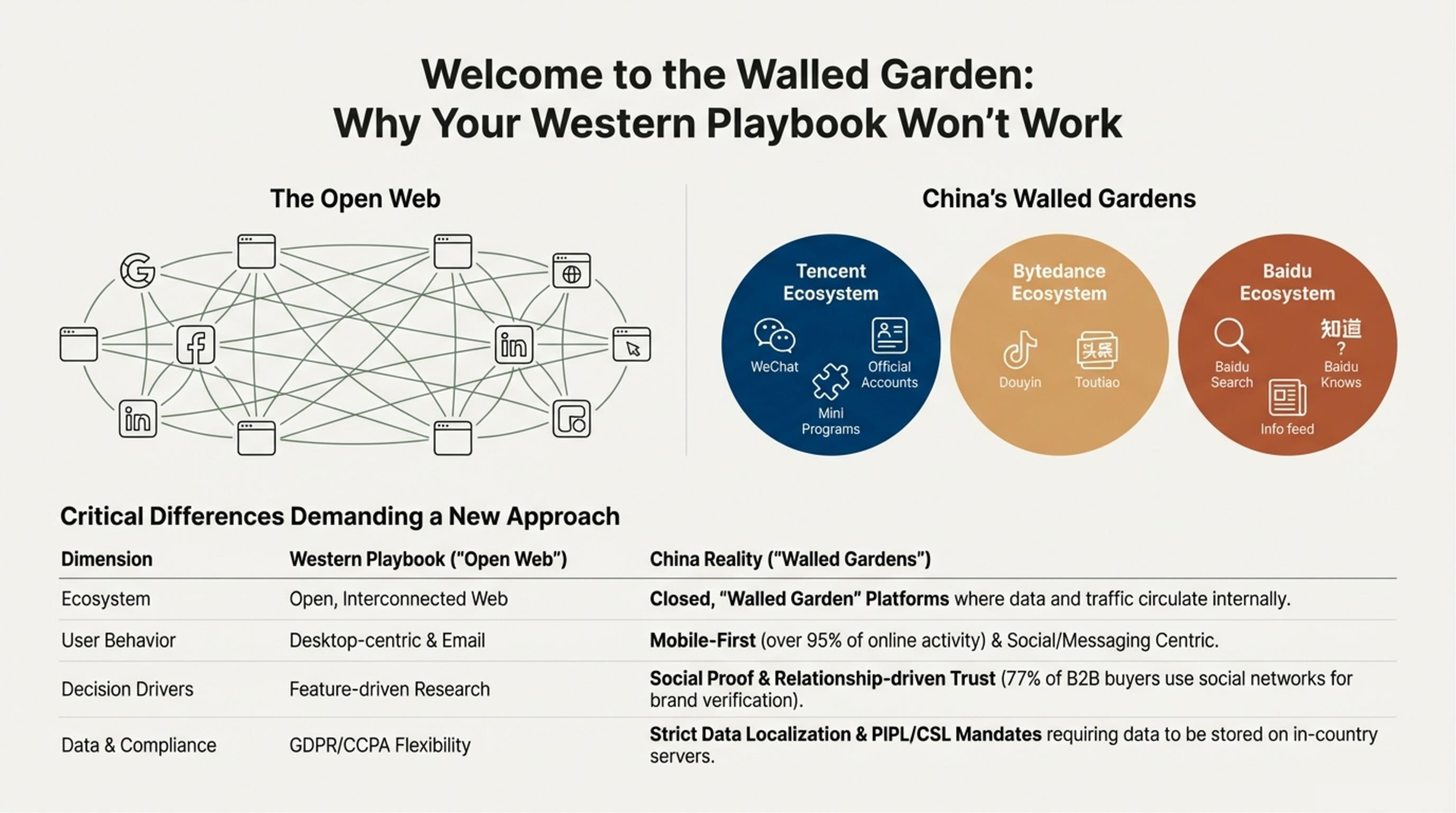
By 2026, over 95% of B2B digital activity in China occurs on mobile devices within these environments. The traditional standalone desktop website has been relegated to a secondary “trust certificate”—a digital business card procurement officers visit only to verify your existence. If your customers never leave WeChat, vertical industry portals, or AI-native search interfaces, a Western-centric “Open Web” strategy is more than a mistake; it is a strategic forfeiture of the world’s largest B2B market. For 2026, the question is no longer how to drive traffic to your site, but how to embed your presence where the decision-makers already live.
2. Mapping the 2026 B2B Digital Battlefield
The Chinese market is currently governed by the Ministry of Commerce’s “Digital Commerce Three-Year Action Plan (2024-2026),” which mandates the integration of digital tools across the entire marketing chain. To navigate this, Western firms must master a bifurcated search landscape and a new AI-driven discovery paradigm.
The Search Schism: Desktop vs. Mobile
Strategy must be split based on user context and hardware, as the market share is nearly a dead heat between two different giants.
| Feature | Desktop Search (Office-Based) | Mobile Search (Social/Transactional) |
| Market Leader | Bing (52.96% share) | Baidu (52.79% share) |
| Strategic Focus | Technical spec review & deep research. | Quick inquiry & social validation. |
| Integration | Microsoft ecosystem & structured data. | Baidu “Smart Programs” & Baijiahao. |
| Requirement | High-speed local loading & multi-lingual SEO. | Mobile-first UX & AI-native interaction. |
The Rise of AI Entrances (AEO & GEO)
The era of simple keyword-based SEO is over. In 2026, entry points are defined by intent-based answers:
- AEO (Answer Engine Optimization): This focuses on “Zero-Click” results. To win, technical content must be formatted into 50-150 word fragments with explicit Schema markup (FAQ, HowTo). This allows AI engines to pull your data directly into the user interface.
- GEO (Generative Engine Optimization): This targets the recommendation engines of LLMs. You must move from “Keywords” to Dialogue Scripts and Scenario-based cases.
- DeepSeek: For technical and developer-heavy audiences.
- Wenxin Yiyan & Tongyi Qianwen: For corporate and industrial decision-makers.
- Doubao: For local service and practical, on-the-ground implementation queries.
The Walled Gardens
- WeChat: The absolute hub for relationship management and trust.
- Douyin: The new standard for visual product demos and “factory-floor” transparency.
- Vertical Portals: Platforms like 1688 and industry-specific forums remain critical for technical validation and procurement comparison.
3. Strategic Shifts for Western B2B Decision-Makers
Success in 2026 requires moving away from “exposure” and toward deep technical and regulatory integration.
- From Brand Awareness to Quantifiable Tech-Integration: Budgets have shifted from general advertising to building local data assets and “AI-native” content. Marketing is now a technical investment, not just a creative one.
- The Multi-Role Decision Committee: B2B decisions now involve technical, finance, and business heads. Your content must be mapped to these personas: 3D models and dynamic charts for engineers to lower the “understanding threshold,” and ROI calculators for finance leads.
- The “Walled Garden” Strategy: A single-platform approach is a recipe for failure. You must maintain independent, localized operations across Baidu, WeChat, and vertical portals to capture the fragmented customer journey.
- Entrance-as-a-Service (IoT Integration): Following the “S2B2B” model, the digital entry point is no longer just a search result—it is the sensor data on the customer’s machinery. By 2026, leading firms use IoT data to trigger “predictive maintenance” prompts, turning a service alert into a marketing entry point.
4. Performance Benchmarks: Choosing Your Entry Point
The following data reflect the 2026 landscape where digital commerce is projected to exceed 40 trillion RMB.
| Channel Type | Average CPL (RMB) | MQL Conversion Rate | ROI Level | Sales Cycle |
| Content Marketing | 300 – 600 | 10% – 20% | High | 6-12 Months |
| SEO / Natural Search | 150 – 300 | 8% – 15% | High | 6-9 Months |
| Paid Search Ads | 500 – 1,200 | 5% – 10% | Medium | 3-6 Months |
| Vertical Portals | 800 – 2,000 | 3% – 8% | Low-Mid | 4-8 Months |
| Social Media | 200 – 500 | 2% – 6% | Low-Mid | Variable |
Strategic Analysis: While Paid Search offers immediate leads, its “Budget-to-Zero” effect—where visibility vanishes the moment spending stops—makes it a risky primary strategy. Conversely, Content Marketing and SEO achieve average conversion rates of 3.0% – 5.0% (climbing to 8% for best-in-class industrial leaders). These channels build “Digital Assets” with a high Life Time Value (LTV), offering a compounding return that resists market volatility.
5. Implementation Roadmap: 2026 Strategic Action Plan
Phase 1: Foundation (0-6 Months)
- Hard Compliance: Secure ICP licenses and ensure data resides on Mainland servers.
- Private Deployment (私有化部署): Many Chinese State-Owned Enterprises (SOEs) now demand private data hosting for security. Establish this infrastructure early to avoid disqualification from major tenders.
- Baseline Localization: Adapt technical content into localized, high-authority whitepapers.
Phase 2: Expansion (7-12 Months)
- Tech Stack Integration: Deploy localized Marketing Automation (MA) and Customer Data Platforms (CDP) to synthesize a “single view” of the customer across the Walled Gardens.
- AEO/GEO Launch: Refactor technical documentation into AI-friendly fragments for recommendation by Wenxin Yiyan and DeepSeek.
Phase 3: Deep Cultivation (13-24 Months)
- Predictive Service Models: Integrate IoT data to shift from “selling products” to “Entrance-as-a-Service,” providing maintenance before a client even realizes a need exists.
- XR Deployment: Utilize Extended Reality (XR) for remote, immersive 3D product demonstrations, crucial for complex machinery and industrial equipment.
In 2026, adherence to the Personal Information Protection Law (PIPL) and the Data Security Law is non-negotiable. Operating without localized data hosting or an ICP license is no longer a “calculated risk”—it is an invitation for immediate business interruption and severe legal penalties.
6. 2026 Outlook: The Future of B2B Interaction
The 2026 B2B market is defined by speed and predictive intelligence. AI-Native Content has accelerated technical production by 3x, allowing for real-time personalization of briefs and whitepapers. Simultaneously, the transition from “selling a product” to “providing a predictive service” via IoT and sensor data has become the gold standard for industrial loyalty.
Closing Thought: Success in China requires Strategic Patience. You are not just buying traffic; you are building a localized, compliant, and AI-optimized digital infrastructure. Those who invest in building deep, local digital trust today will own the entry points of tomorrow.